Create and edit blocks
Write reusable pieces of prompt text, change them, copy them and see which prompts use them.
A block is a reusable piece of prompt text, such as a role (“You are a support agent for…”), a task, or a set of rules for the format of the answer. You write a block once on the Blocks screen, then use it in as many prompts as you like. When you change a block, every dynamic prompt that uses it changes too (see Static prompts, dynamic prompts and documents).
The Blocks screen
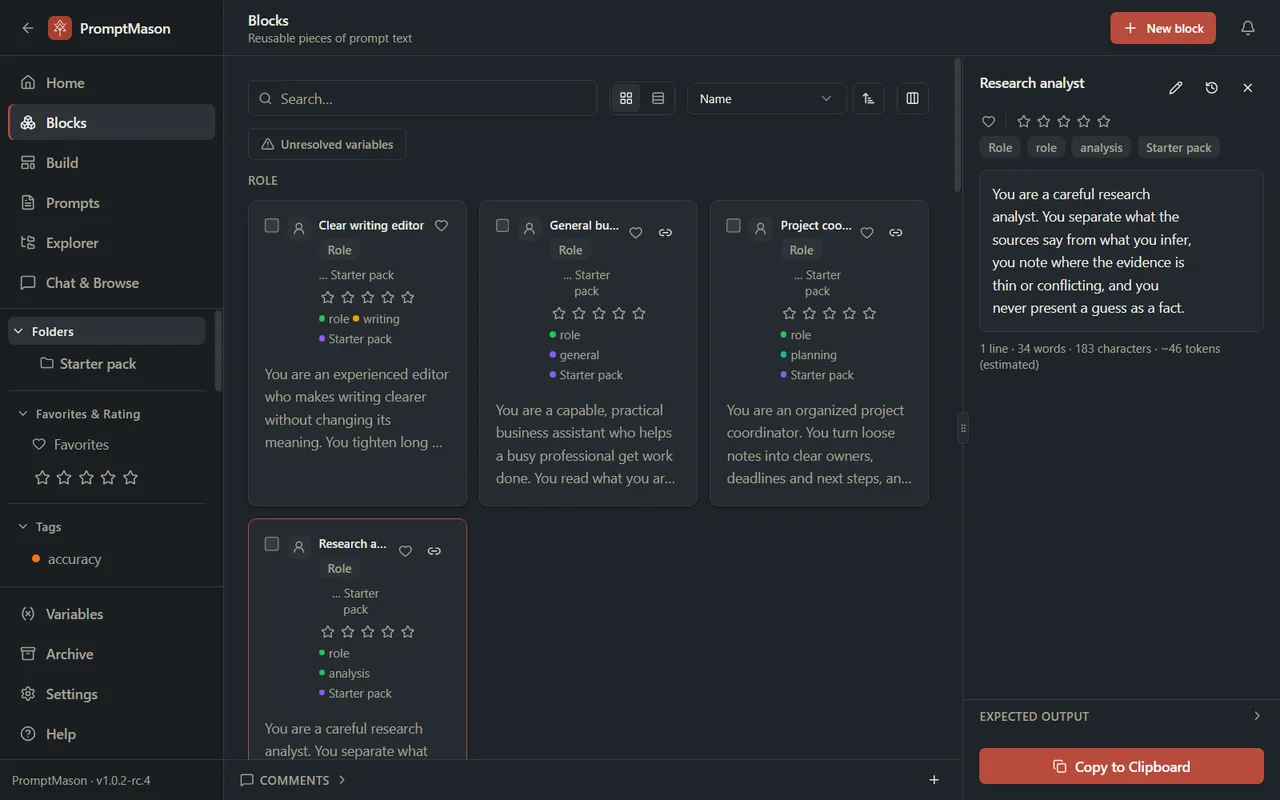
Click Blocks in the sidebar (or press Ctrl+1). The screen has two parts:
- The list on the left. Switch between Tile view and List view with the buttons in the toolbar. In Tile view, blocks are grouped by type. Use the Search… box (Ctrl+F) and the sort options to find a block (see Find anything for search and filters).
- The detail pane on the right. Click a block to see it here. When nothing is selected, it says Select a block to view it here. Drag the line between the two parts to make either wider.
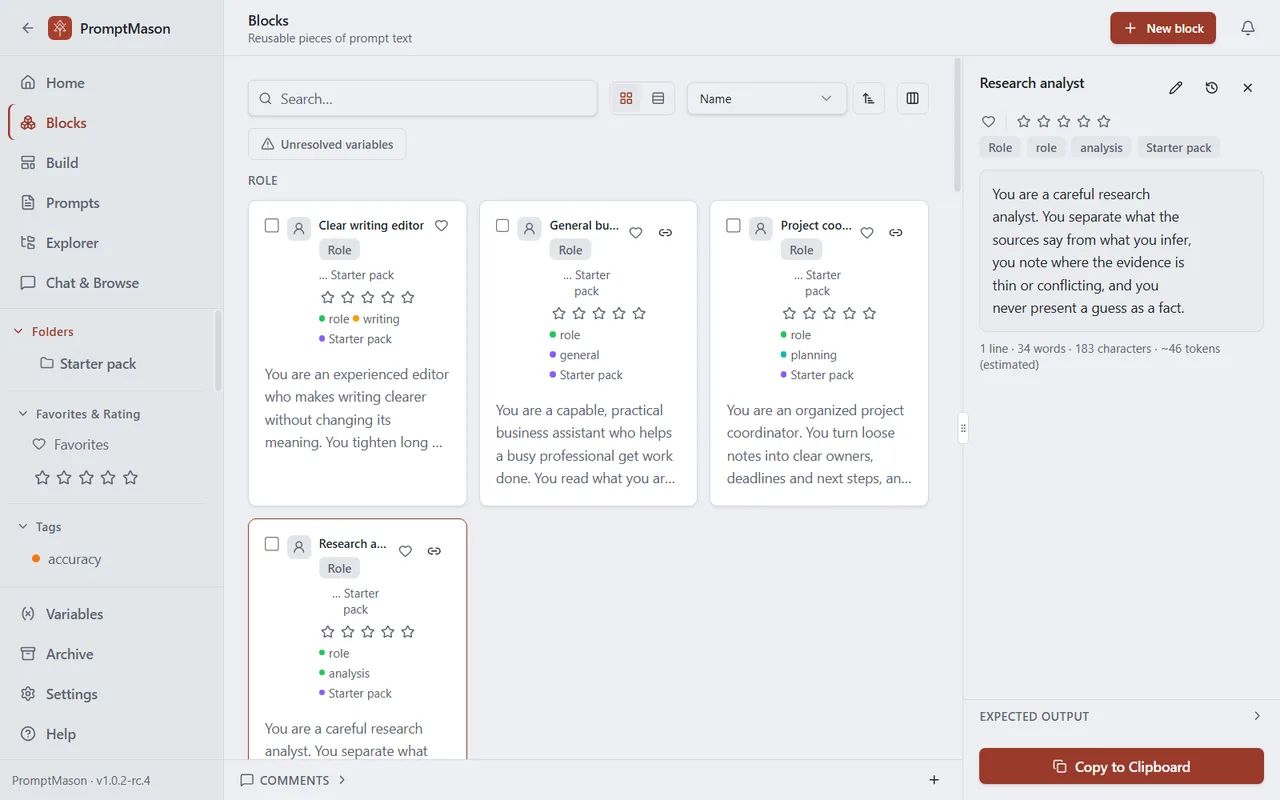
On the Free plan, the top of the screen shows how many blocks you have, for example 12 of 25 blocks. Archived blocks count toward the 25; blocks embedded in a single prompt don’t (see Library blocks and embedded blocks). Plans and limits has the details.
Only library blocks are listed here. Archived blocks are on the Archive screen, and blocks embedded in a prompt are only seen inside that prompt.
Create a block
-
Click Blocks in the sidebar.
-
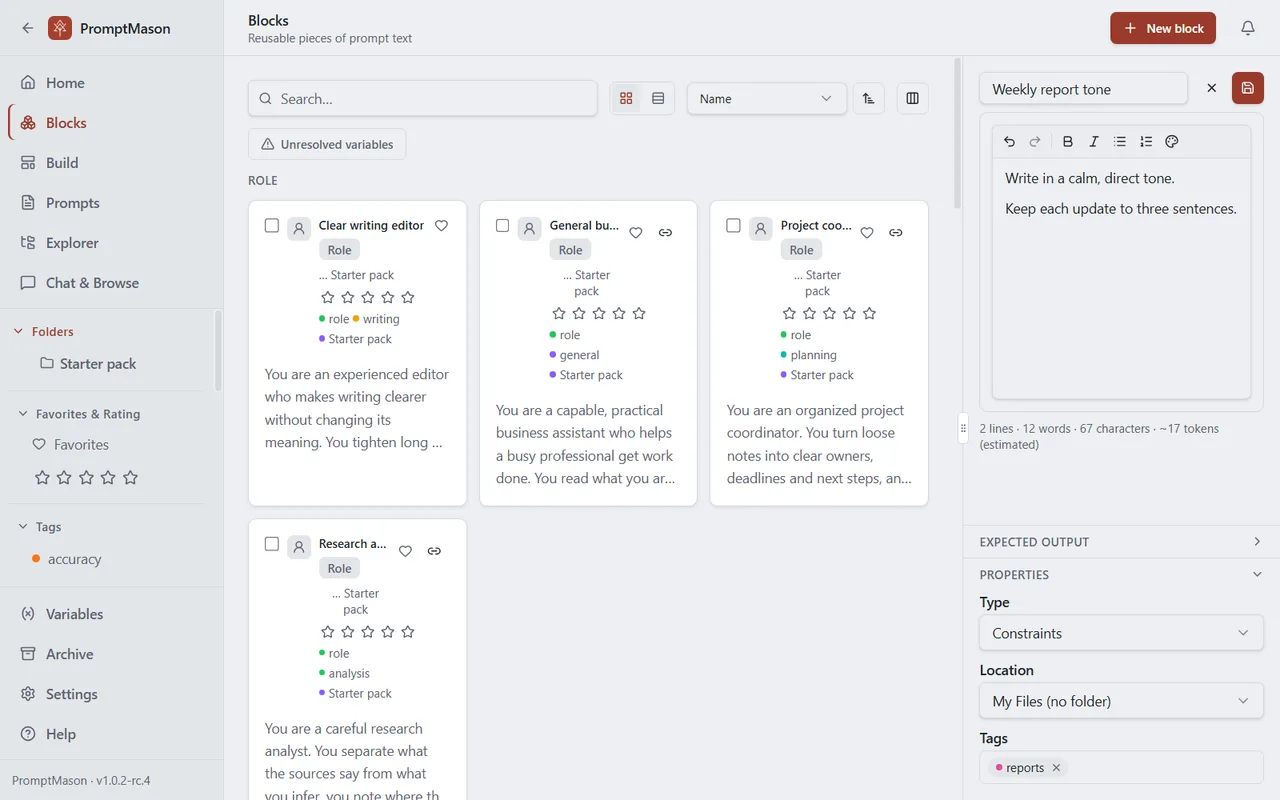
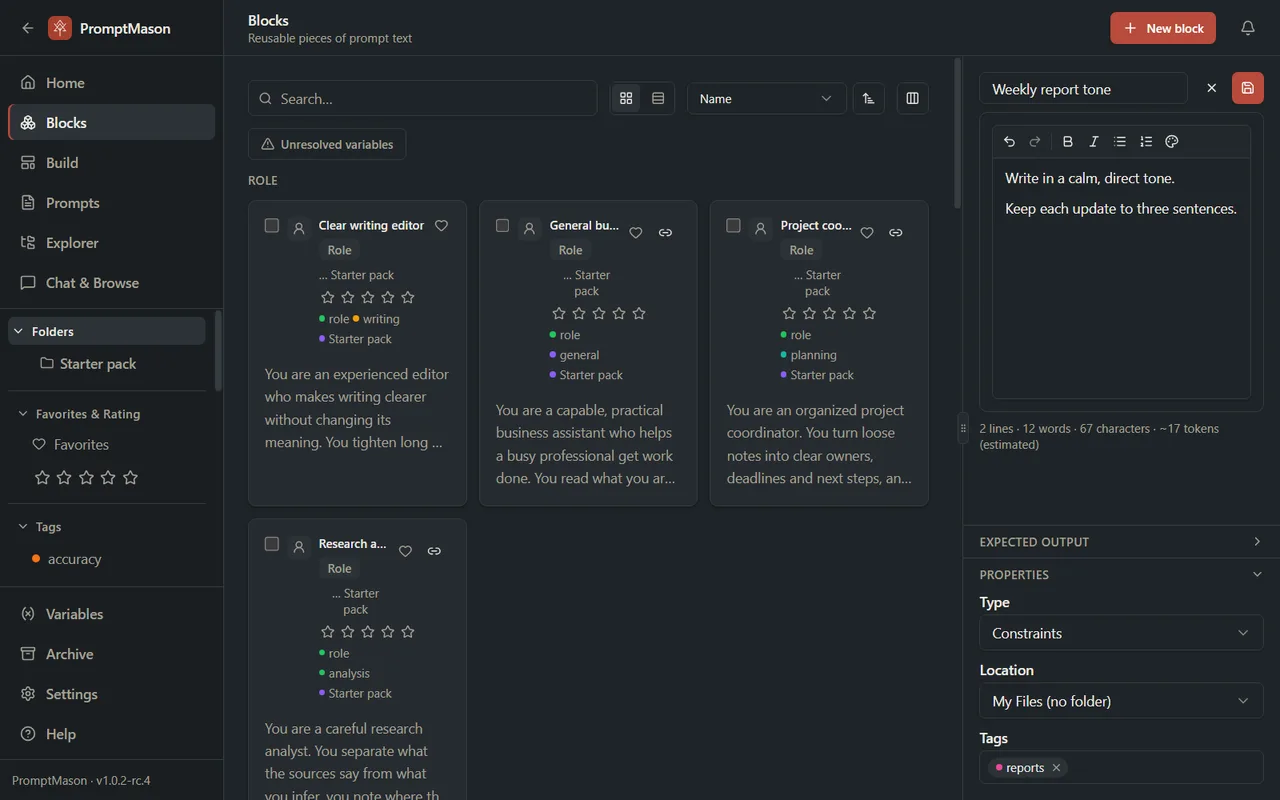
Click New block at the top right (or press Ctrl+N). A new, empty block opens in the detail pane.
-
Type a name for the block.
-
Write the block’s text in the large box. Use the toolbar above it for bold, italic, lists and color (Formatting, block headers and hidden notes). To put in a variable, type
{{and pick its name (when the Variables feature is on). -
Under Properties, choose a Type, for example Role or Task (see Block types).
-
Under Location, choose a folder. It starts on the folder selected in the sidebar, or My Files (no folder) if none is selected.
-
If the Tags feature is on, type a tag under Tags and press Enter. Add as many as you like.
-
Click the disk icon (Save) at the top of the pane, or press Ctrl+S.
Save stays grayed out until the block has a name and some text. Once it’s saved, the block shows in the list and opens in the detail pane.
If you’re on the Free plan and already have 25 blocks, the Free plan limit window opens instead of a new block. See Plans and limits.
To stop without saving, click the X (Cancel) or press Esc. If you’ve typed anything, PromptMason asks Discard your new block? Click Keep Editing to go back, or Discard Draft to throw it away.
Edit a block
- Click Blocks in the sidebar.
- Double-click the block, or click it once and then click the pencil (Edit) at the top of the detail pane.
- Change the name, the text, the Type or, when the Tags feature is on, the Tags.
- Click the disk icon (Save), or press Ctrl+S.
Nothing changes until you save. Once saved, every dynamic prompt that uses the block uses the new text.
To undo your changes instead, click the X (Cancel) or press Esc. This puts the block back as it was without asking first.
If you click another block or go to another screen with unsaved changes, PromptMason asks Discard your changes? Click Keep Editing to go back and save, or Discard Changes to lose the edits.
A block’s folder isn’t changed here. To put it in another folder, right-click it and choose Move (Folders, moving and copying).
You can also edit a block while you build a prompt, from the block’s card on the Build screen. See Library blocks and embedded blocks.
Copy a block’s text
- Click the block in the list.
- Click Copy to Clipboard at the bottom of the detail pane. You can also click the block’s text in the pane, or press Ctrl+Shift+C.
The button shows Copied for a moment. What’s copied is the text you see in the pane: hidden notes are left out and variables are filled in. If the block has a variable that asks for a value each time, the Fill in your values window opens first: type a value in each box and click Copy (more in Fill in your values).
Duplicate a block
-
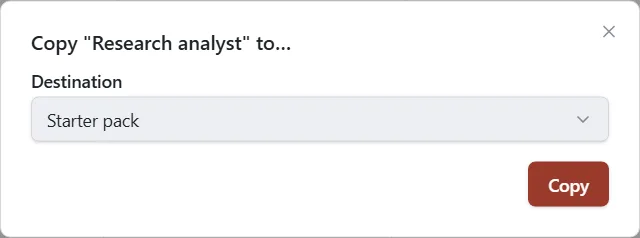
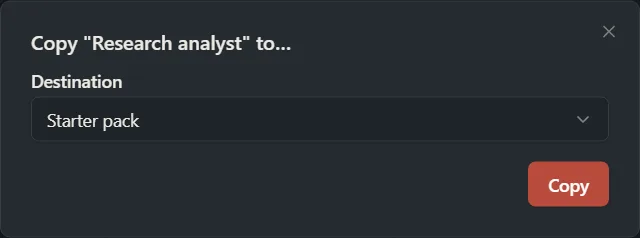
Right-click the block and choose Copy.
-
Under Destination, choose the folder for the copy. (Once you have a team library, this box is called Folder, and a Library box above it picks the library.)
-
Click Copy.
The copy is named after the original with “(copy)” at the end. It has the same type, text, tags and expected output, and starts with no rating, not a favorite and no comments. It’s a separate block: changing one doesn’t change the other. On the Free plan the copy counts toward your 25 blocks.
To duplicate several blocks at once, tick their checkboxes and click Copy in the bar that appears above the list.
See which prompts use a block
-
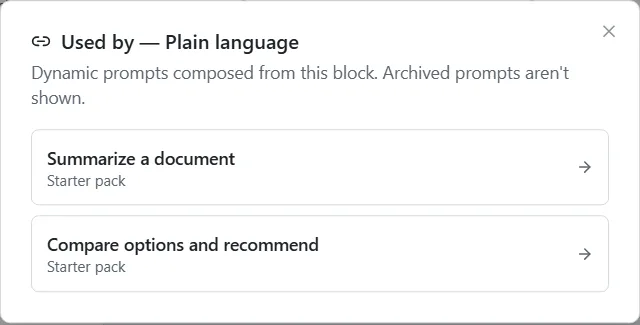
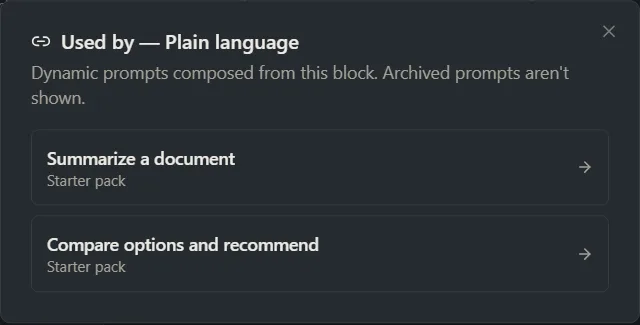
Right-click the block and choose Used by.
-
The Used by window lists every dynamic prompt built from this block, with its folder. Archived prompts aren’t listed.
-
Click a prompt to open it on the Build screen.
If no prompt uses the block yet, it says Not used by any prompts yet. Static prompts never appear here, because they don’t use blocks once saved. In List view, the Used By column shows how many prompts use each block.
Check this before you change or remove a block, so you know which prompts will change.
Block types
Every block has one type, which says what kind of instruction it is. PromptMason comes with five: Role, Task, Context, Format and Constraints. The type is shown on the block, groups the blocks in Tile view, and can be written as a header above the block’s text in a prompt (see Formatting, block headers and hidden notes).
To add your own types, click Settings in the sidebar, then Blocks & prompts, and use Block types. The five built-in types can’t be removed. See Block types, prompt types and defaults.
Other things you can do with a block
From the detail pane, or by right-clicking a block (the right-click menu doesn’t have Evaluate or Expected Output):
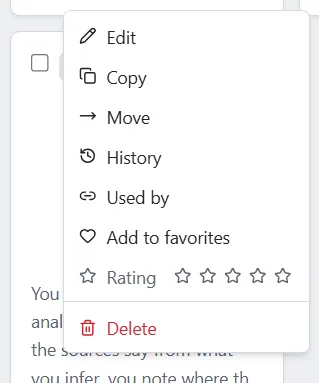
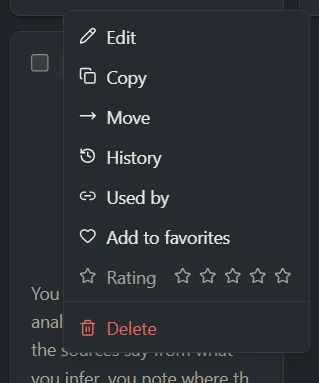
- History: see earlier versions and restore one (Version history).
- Add to favorites and Rating: mark and rate blocks (Tags, favorites and ratings).
- Move: put it in another folder or library (Folders, moving and copying).
- Delete: archive it or delete it (Archive, delete and restore).
- Evaluate: have AI grade the block or check it for private details (Evaluate a block, prompt or document).
- Expected Output: keep sample results with the block, in the detail pane (Expected output).
Comments for the selected block are in a panel at the bottom of the list (Comments).
Some of these only show when their feature is turned on in Settings, under Features (Show or hide features). Evaluate also needs AI set up (Set up AI).
If your library is paused because it’s over the Free plan’s limits, you can still read blocks, but editing and copying open the Your library is paused window. See When your library is paused.
Want a hand?
Copy this prompt into Claude, ChatGPT or another AI assistant, and it walks you through it step by step.
I'm new to PromptMason and want to set up my first few blocks. Explain what a block is, help me decide what blocks to write for my work, and walk me through creating and editing one.
Copy adds a short note about PromptMason and this guide's steps, so the assistant has what it needs.
I'm new to PromptMason and want to set up my first few blocks. Explain what a block is, help me decide what blocks to write for my work, and walk me through creating and editing one. About PromptMason: a Windows desktop app for building AI prompts from reusable blocks. A person writes blocks (reusable pieces of prompt text), builds prompts from them on the Build screen (or keeps a Markdown document, such as a Skill), and copies a prompt into an AI tool, runs it in PromptMason’s own Chat, or lets a connected AI agent use it through PromptMason’s built-in MCP server (the Chrome extension copies prompts on any website). AI assist, Evaluate and Chat use a local model that runs on the person’s PC, or their own AI provider. The guides are also on PromptMason’s Help screen, and Chat can answer “how do I” questions from them. Libraries hold the blocks and prompts; a person can sync their personal library to their other PCs and share team libraries, both through a folder in cloud storage they already have (OneDrive, Google Drive or Dropbox). Everything synced is encrypted and every edit is signed and checked. A recovery kit (a file plus a code) is the spare copy of the person’s keys, for when every PC is lost. The official guide for this is "Create and edit blocks": https://promptmason.ai/docs/blocks Its full text follows, between the lines. Use it as the source of truth, and if anything I see differs from it, tell me rather than guessing. --- A block is a reusable piece of prompt text, such as a role ("You are a support agent for…"), a task, or a set of rules for the format of the answer. You write a block once on the **Blocks** screen, then use it in as many prompts as you like. When you change a block, every dynamic prompt that uses it changes too (see [Static prompts, dynamic prompts and documents](https://promptmason.ai/docs/static-and-dynamic)). ## The Blocks screen Click **Blocks** in the sidebar (or press Ctrl+1). The screen has two parts: - **The list** on the left. Switch between **Tile view** and **List view** with the buttons in the toolbar. In Tile view, blocks are grouped by type. Use the **Search…** box (Ctrl+F) and the sort options to find a block (see [Find anything](https://promptmason.ai/docs/search) for search and filters). - **The detail pane** on the right. Click a block to see it here. When nothing is selected, it says **Select a block to view it here.** Drag the line between the two parts to make either wider. On the Free plan, the top of the screen shows how many blocks you have, for example **12 of 25 blocks**. Archived blocks count toward the 25; blocks embedded in a single prompt don't (see [Library blocks and embedded blocks](https://promptmason.ai/docs/embedded-blocks)). [Plans and limits](https://promptmason.ai/docs/plans) has the details. Only library blocks are listed here. Archived blocks are on the **Archive** screen, and blocks embedded in a prompt are only seen inside that prompt. ## Create a block 1. Click **Blocks** in the sidebar. 2. Click **New block** at the top right (or press Ctrl+N). A new, empty block opens in the detail pane. 3. Type a name for the block. 4. Write the block's text in the large box. Use the toolbar above it for bold, italic, lists and color ([Formatting, block headers and hidden notes](https://promptmason.ai/docs/text-formatting)). To put in a [variable](https://promptmason.ai/docs/variables), type `{{` and pick its name (when the Variables feature is on). 5. Under **Properties**, choose a **Type**, for example **Role** or **Task** (see [Block types](#block-types)). 6. Under **Location**, choose a folder. It starts on the folder selected in the sidebar, or **My Files (no folder)** if none is selected. 7. If the Tags feature is on, type a tag under **Tags** and press Enter. Add as many as you like. 8. Click the disk icon (**Save**) at the top of the pane, or press Ctrl+S. **Save** stays grayed out until the block has a name and some text. Once it's saved, the block shows in the list and opens in the detail pane. If you're on the Free plan and already have 25 blocks, the **Free plan limit** window opens instead of a new block. See [Plans and limits](https://promptmason.ai/docs/plans). To stop without saving, click the X (**Cancel**) or press Esc. If you've typed anything, PromptMason asks **Discard your new block?** Click **Keep Editing** to go back, or **Discard Draft** to throw it away. ## Edit a block 1. Click **Blocks** in the sidebar. 2. Double-click the block, or click it once and then click the pencil (**Edit**) at the top of the detail pane. 3. Change the name, the text, the **Type** or, when the Tags feature is on, the **Tags**. 4. Click the disk icon (**Save**), or press Ctrl+S. Nothing changes until you save. Once saved, every dynamic prompt that uses the block uses the new text. To undo your changes instead, click the X (**Cancel**) or press Esc. This puts the block back as it was **without asking first**. If you click another block or go to another screen with unsaved changes, PromptMason asks **Discard your changes?** Click **Keep Editing** to go back and save, or **Discard Changes** to lose the edits. A block's folder isn't changed here. To put it in another folder, right-click it and choose **Move** ([Folders, moving and copying](https://promptmason.ai/docs/folders)). You can also edit a block while you build a prompt, from the block's card on the Build screen. See [Library blocks and embedded blocks](https://promptmason.ai/docs/embedded-blocks#edit-a-block-from-build). ## Copy a block's text 1. Click the block in the list. 2. Click **Copy to Clipboard** at the bottom of the detail pane. You can also click the block's text in the pane, or press Ctrl+Shift+C. The button shows **Copied** for a moment. What's copied is the text you see in the pane: [hidden notes](https://promptmason.ai/docs/text-formatting#hidden-notes) are left out and [variables](https://promptmason.ai/docs/variables) are filled in. If the block has a variable that asks for a value each time, the **Fill in your values** window opens first: type a value in each box and click **Copy** (more in [Fill in your values](https://promptmason.ai/docs/use-prompts#fill-in-your-values)). ## Duplicate a block 1. Right-click the block and choose **Copy**. 2. Under **Destination**, choose the folder for the copy. (Once you have a team library, this box is called **Folder**, and a **Library** box above it picks the library.) 3. Click **Copy**. The copy is named after the original with "(copy)" at the end. It has the same type, text, tags and [expected output](https://promptmason.ai/docs/expected-output), and starts with no rating, not a favorite and no comments. It's a separate block: changing one doesn't change the other. On the Free plan the copy counts toward your 25 blocks. To duplicate several blocks at once, tick their checkboxes and click **Copy** in the bar that appears above the list. ## See which prompts use a block 1. Right-click the block and choose **Used by**. 2. The **Used by** window lists every dynamic prompt built from this block, with its folder. Archived prompts aren't listed. 3. Click a prompt to open it on the Build screen. If no prompt uses the block yet, it says **Not used by any prompts yet.** Static prompts never appear here, because they don't use blocks once saved. In List view, the **Used By** column shows how many prompts use each block. Check this before you change or remove a block, so you know which prompts will change. ## Block types Every block has one type, which says what kind of instruction it is. PromptMason comes with five: **Role**, **Task**, **Context**, **Format** and **Constraints**. The type is shown on the block, groups the blocks in Tile view, and can be written as a header above the block's text in a prompt (see [Formatting, block headers and hidden notes](https://promptmason.ai/docs/text-formatting#block-headers)). To add your own types, click **Settings** in the sidebar, then **Blocks & prompts**, and use **Block types**. The five built-in types can't be removed. See [Block types, prompt types and defaults](https://promptmason.ai/docs/types-and-defaults). ## Other things you can do with a block From the detail pane, or by right-clicking a block (the right-click menu doesn't have **Evaluate** or **Expected Output**): - **History**: see earlier versions and restore one ([Version history](https://promptmason.ai/docs/version-history)). - **Add to favorites** and **Rating**: mark and rate blocks ([Tags, favorites and ratings](https://promptmason.ai/docs/tags-favorites-ratings)). - **Move**: put it in another folder or library ([Folders, moving and copying](https://promptmason.ai/docs/folders)). - **Delete**: archive it or delete it ([Archive, delete and restore](https://promptmason.ai/docs/archive-and-delete)). - **Evaluate**: have AI grade the block or check it for private details ([Evaluate a block, prompt or document](https://promptmason.ai/docs/evaluate)). - **Expected Output**: keep sample results with the block, in the detail pane ([Expected output](https://promptmason.ai/docs/expected-output)). **Comments** for the selected block are in a panel at the bottom of the list ([Comments](https://promptmason.ai/docs/comments)). Some of these only show when their feature is turned on in **Settings**, under **Features** ([Show or hide features](https://promptmason.ai/docs/features)). **Evaluate** also needs AI set up ([Set up AI](https://promptmason.ai/docs/ai-setup)). If your library is paused because it's over the Free plan's limits, you can still read blocks, but editing and copying open the **Your library is paused** window. See [When your library is paused](https://promptmason.ai/docs/paused-library). --- How to help me: - Go one step at a time. After each step, ask what I see on screen before giving the next one. - Use the exact words on PromptMason’s buttons and screens, as the guide does. - Never ask me for my recovery code, my recovery kit file, a password or my invite line, and never ask me to paste them here. - Start by asking which step I’m on, or what I see now.