Prompt sets
Put prompts in order as one prompt set, copy it, and let an AI agent run the prompts one after another.
Want a hand?
Copy this prompt into Claude, ChatGPT or another AI assistant, and it walks you through it step by step.
I want to make a prompt set in PromptMason so an AI agent can run my prompts one after another. Walk me through making one from “Prompts”, then “New”, then “Prompt set”, putting the prompts in order, and how an agent runs it.
Copy adds a short note about PromptMason and this guide's steps, so the assistant has what it needs.
I want to make a prompt set in PromptMason so an AI agent can run my prompts one after another. Walk me through making one from “Prompts”, then “New”, then “Prompt set”, putting the prompts in order, and how an agent runs it. About PromptMason: a desktop app for Windows and Mac for building AI prompts from reusable blocks. A person writes blocks (reusable pieces of prompt text), builds prompts from them on the Build screen (or writes a Skill for an AI app, or keeps a Markdown document), and copies a prompt into an AI tool, runs it in PromptMason’s own Chat, or lets a connected AI agent use it through PromptMason’s built-in MCP server (the Chrome extension copies prompts on any website). AI assist, Evaluate and Chat use a local model that runs on the person’s computer, or their own AI provider. The guides are also on PromptMason’s Help screen, and Chat can answer “how do I” questions from them. Libraries hold the blocks and prompts; a person can sync their personal library to their other computers and share team libraries, both through a folder in cloud storage they already have (OneDrive, Google Drive or Dropbox). Everything synced is encrypted and every edit is signed and checked. A recovery kit (a file plus a code) is the spare copy of the person’s keys, for when every computer is lost. The official guide for this is "Prompt sets": https://promptmason.ai/docs/prompt-sets Its full text follows, between the lines. Use it as the source of truth, and if anything I see differs from it, tell me rather than guessing. --- A prompt set is a list of your prompts, in order. Each prompt in it is a step. Copy the set and you get every step's text, one after another. Give the set to an AI agent and it can run the steps one at a time, using what it learned in each step for the next one. Use a prompt set for work you always do in the same order. For example: research a topic, then write an outline, then write the draft. A prompt set is listed with your prompts on the **Prompts** screen, with **Prompt set** as its kind. It counts as one prompt on the Free plan. ## Make a prompt set 1. Click **Prompts** in the sidebar. 2. Click **New**, then **Prompt set**. The Build screen opens. The list on the left is called **Prompts**, and the canvas says **Drag prompts here to build your prompt set**. 3. Drag a prompt from the list onto the canvas. Or double-click it to add it at the end. 4. Add the other prompts the same way. You can add the same prompt more than once. 5. Type a name in the box at the top, next to **Build**. 6. Optional: under **Properties** on the right, add a **Description** and **Tags**, and choose a **Location** (a folder). 7. Click **Save prompt set**. PromptMason saves the set and opens the **Prompts** screen. To save and keep working, click **Apply** instead. You can also start on the Build screen: at the top, set **Build a** to **Prompt set**. The list on the left changes from blocks to prompts. ## What you can add The list shows the prompts a set can use: - Static prompts and dynamic prompts. - Only prompts from the set's own library. Skills, Markdown documents, other prompt sets and archived prompts aren't listed. A set can hold up to 50 steps. The list has the same **Search…** box and sort buttons as the block list. It also follows the folder, tag, favorites and rating filters chosen in the sidebar. ## Put the steps in order - Drag a step by its handle (the dotted grip on its left) to a new place. - Or click the up and down arrows on the step. - To take a step out, click the **X** on it. The **Preview** on the right shows the whole set as it will be copied. A step's heading can be its number, the prompt's name, or both, such as **Step 1: Research**, then the text of that prompt. You choose below. ## Choose each step's heading Each step on the canvas has two boxes, **Include Step Number** and **Include Name**, like the **Include Name** and **Include Type** boxes on a block. Both start unticked, so a step you add has no heading. Tick one to put that part in the step's heading. To change how new steps start, go to **Settings**, then **Blocks & prompts**, and look under **When you add a prompt to a prompt set**. See [Block types, prompt types and defaults](https://promptmason.ai/docs/types-and-defaults#include-the-step-number-or-name). Here is what each choice writes: | Ticked | The heading in the copy | | --- | --- | | Both | `## Step 2: Outline` | | **Include Step Number** only | `## Step 2` | | **Include Name** only | `## Outline` | | Neither | No heading. The step's text follows the step before it, with a blank line between. | The choice belongs to that step alone. The same prompt used as another step keeps its own boxes. The **Preview**, **Copy**, and the text an AI agent gets all follow the boxes. Click **Save prompt set** or **Update prompt set** to keep your choices. ## Switch between a prompt and a prompt set On a new item, setting **Build a** to **Prompt set**, or away from it, clears the canvas. A prompt set holds prompts, and a prompt holds blocks. If something is already on the canvas, PromptMason asks first: - **Cancel** leaves everything as it is. - **Clear and change** empties the canvas and switches. A saved prompt set stays a prompt set, and a saved prompt can't become one. ## Change a prompt set 1. On the **Prompts** screen, click the set. 2. Click the pencil (**Open in Build**), or double-click the set. 3. Add, move or take out steps, then click **Update prompt set**. Each saved change is kept in the set's history. See [Version history](https://promptmason.ai/docs/version-history). ## Copy a prompt set Click the set on the **Prompts** screen. The detail pane lists its **Steps**. Click a step's name to open that prompt. Under the steps is the text of the whole set. If the set has more than about six steps, the list scrolls, so the text stays in view. The Chrome extension's panel lists the steps the same way. Click **Copy to Clipboard**. If any step asks for a value each time, PromptMason asks for it once, and the value goes into every step that uses it. See [Variables](https://promptmason.ai/docs/variables). On the Build screen, the **Copy** button above the **Preview** does the same. ## Let an AI agent run a prompt set An AI agent connected to PromptMason can run the steps one at a time. See [Connect an AI agent](https://promptmason.ai/docs/connect-ai-agent). 1. The agent reads the set with the **get_prompt_set** tool. It gets the steps in order, and how to run them. 2. For each step, the agent gets the prompt's text with **resolve_prompt**, does what it says, and takes the answer into the next step. You can ask the agent in plain words, for example: "Run my Launch plan prompt set." An agent can also make and change sets with **create_prompt_set** and **update_prompt_set**. See [Tools for AI agents](https://promptmason.ai/docs/agent-tools). ## See which sets use a prompt A prompt that a set uses shows **Used by 2 prompt sets** (or **Used by 1 prompt set**) in its detail pane, under its tags. Click it to see the sets, with their folders. Click a set to open it. Sets in the Archive aren't listed. On the **Prompts** screen, the row of a prompt that a set uses has the same link, and the right-click menu has **Used by**. A prompt no set uses has neither. ## A prompt set and its library A set and its prompts stay in the same library. PromptMason won't move a set to another library while it uses prompts in its own. It also won't move a prompt that a set uses. Take the prompt out of the set first, then move it. ## When a step's prompt is archived or deleted - **Archived:** the step still runs. It's marked **Archived** in the list of steps. - **Deleted:** the step shows as **[Prompt removed: name]** until you restore the prompt from Recently deleted. - **In a library the set can't read:** the step shows as **[Prompt unavailable]**. When you delete or archive a prompt that a set uses, PromptMason warns you and names the set. ## On a computer that hasn't updated A computer running an older version of PromptMason shows a prompt set as an empty dynamic prompt. Nothing is lost. The set is back as it was once that computer updates. --- How to help me: - Go one step at a time. After each step, ask what I see on screen before giving the next one. - Use the exact words on PromptMason’s buttons and screens, as the guide does. - Never ask me for my recovery code, my recovery kit file, a password or my invite line, and never ask me to paste them here. - Start by asking which step I’m on, or what I see now.A prompt set is a list of your prompts, in order. Each prompt in it is a step. Copy the set and you get every step’s text, one after another. Give the set to an AI agent and it can run the steps one at a time, using what it learned in each step for the next one.
Use a prompt set for work you always do in the same order. For example: research a topic, then write an outline, then write the draft.
A prompt set is listed with your prompts on the Prompts screen, with Prompt set as its kind. It counts as one prompt on the Free plan.
Make a prompt set
- Click Prompts in the sidebar.
- Click New, then Prompt set. The Build screen opens. The list on the left is called Prompts, and the canvas says Drag prompts here to build your prompt set.
- Drag a prompt from the list onto the canvas. Or double-click it to add it at the end.
- Add the other prompts the same way. You can add the same prompt more than once.
- Type a name in the box at the top, next to Build.
- Optional: under Properties on the right, add a Description and Tags, and choose a Location (a folder).
- Click Save prompt set.
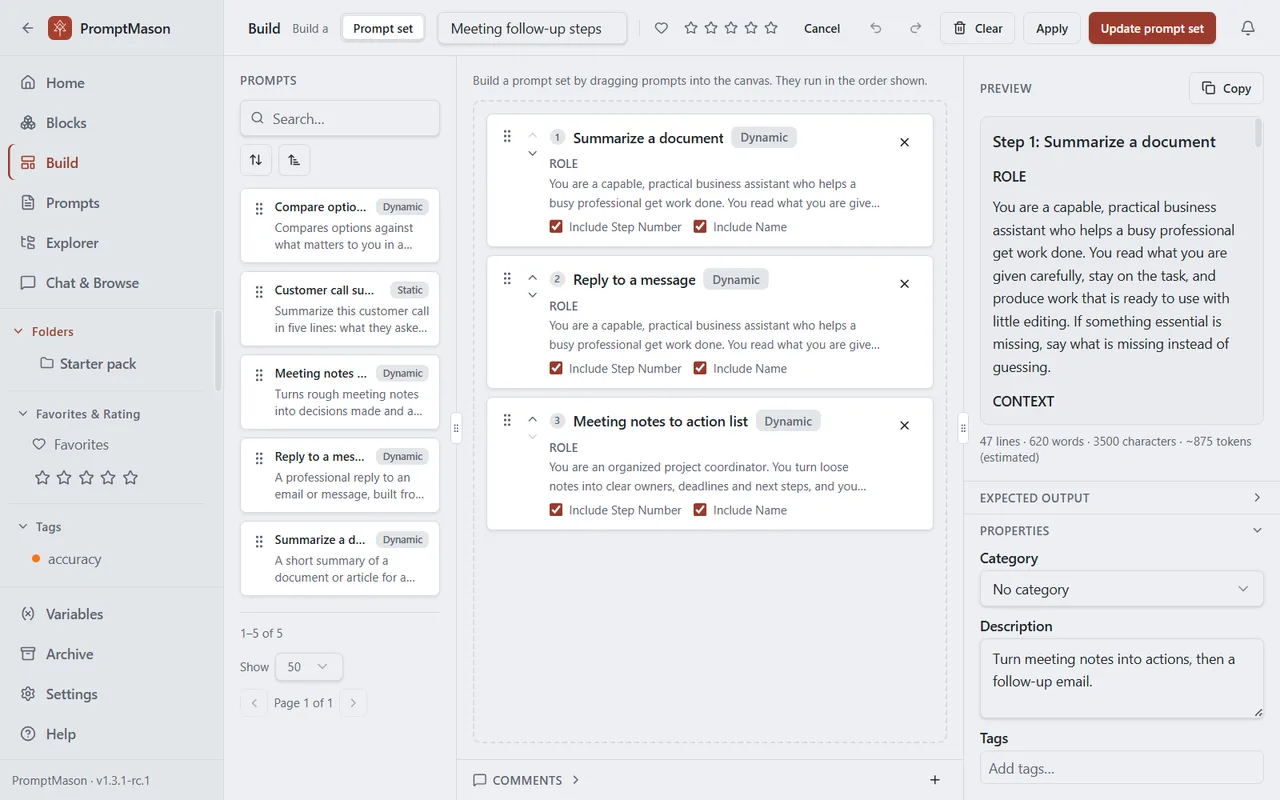
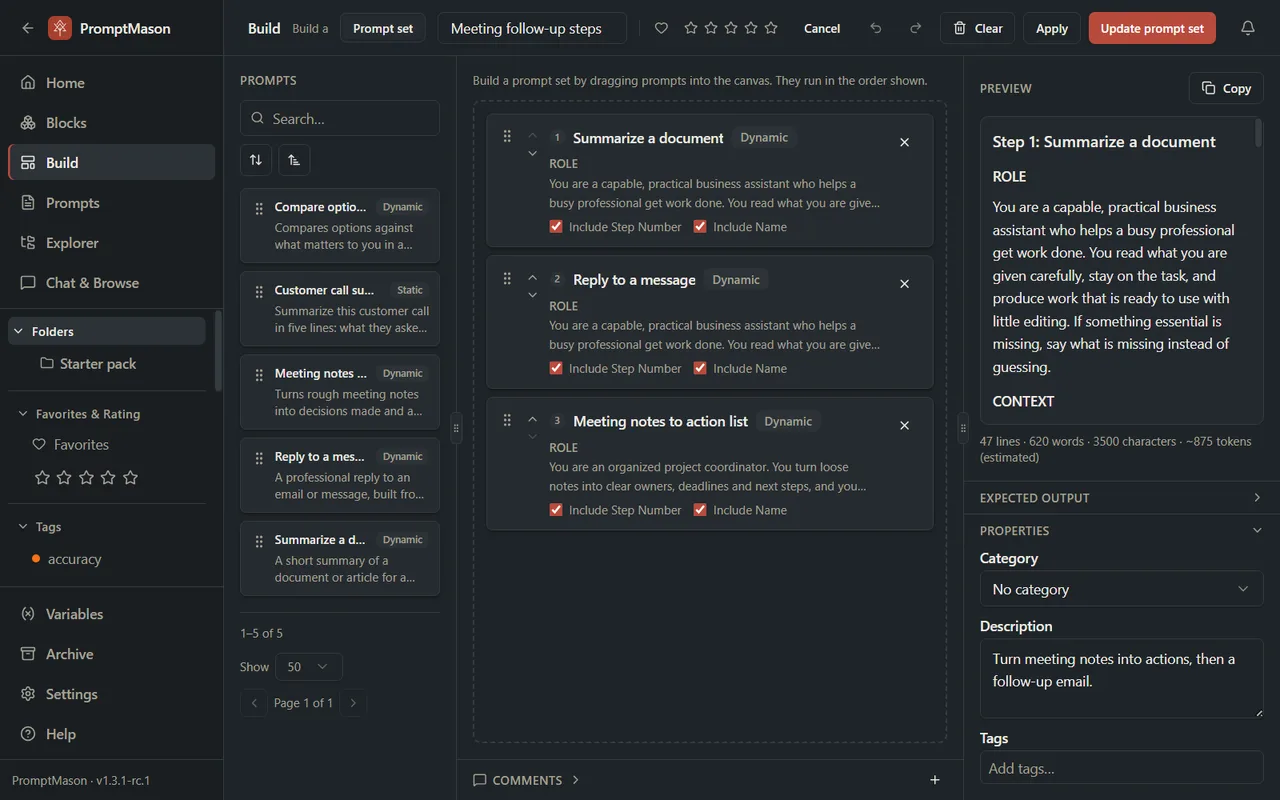
PromptMason saves the set and opens the Prompts screen. To save and keep working, click Apply instead.
You can also start on the Build screen: at the top, set Build a to Prompt set. The list on the left changes from blocks to prompts.
What you can add
The list shows the prompts a set can use:
- Static prompts and dynamic prompts.
- Only prompts from the set’s own library.
Skills, Markdown documents, other prompt sets and archived prompts aren’t listed. A set can hold up to 50 steps.
The list has the same Search… box and sort buttons as the block list. It also follows the folder, tag, favorites and rating filters chosen in the sidebar.
Put the steps in order
- Drag a step by its handle (the dotted grip on its left) to a new place.
- Or click the up and down arrows on the step.
- To take a step out, click the X on it.
The Preview on the right shows the whole set as it will be copied. A step’s heading can be its number, the prompt’s name, or both, such as Step 1: Research, then the text of that prompt. You choose below.
Choose each step’s heading
Each step on the canvas has two boxes, Include Step Number and Include Name, like the Include Name and Include Type boxes on a block. Both start unticked, so a step you add has no heading. Tick one to put that part in the step’s heading. To change how new steps start, go to Settings, then Blocks & prompts, and look under When you add a prompt to a prompt set. See Block types, prompt types and defaults. Here is what each choice writes:
| Ticked | The heading in the copy |
|---|---|
| Both | ## Step 2: Outline |
| Include Step Number only | ## Step 2 |
| Include Name only | ## Outline |
| Neither | No heading. The step’s text follows the step before it, with a blank line between. |
The choice belongs to that step alone. The same prompt used as another step keeps its own boxes.
The Preview, Copy, and the text an AI agent gets all follow the boxes. Click Save prompt set or Update prompt set to keep your choices.
Switch between a prompt and a prompt set
On a new item, setting Build a to Prompt set, or away from it, clears the canvas. A prompt set holds prompts, and a prompt holds blocks. If something is already on the canvas, PromptMason asks first:
- Cancel leaves everything as it is.
- Clear and change empties the canvas and switches.
A saved prompt set stays a prompt set, and a saved prompt can’t become one.
Change a prompt set
- On the Prompts screen, click the set.
- Click the pencil (Open in Build), or double-click the set.
- Add, move or take out steps, then click Update prompt set.
Each saved change is kept in the set’s history. See Version history.
Copy a prompt set
Click the set on the Prompts screen. The detail pane lists its Steps. Click a step’s name to open that prompt. Under the steps is the text of the whole set. If the set has more than about six steps, the list scrolls, so the text stays in view. The Chrome extension’s panel lists the steps the same way.
Click Copy to Clipboard. If any step asks for a value each time, PromptMason asks for it once, and the value goes into every step that uses it. See Variables.
On the Build screen, the Copy button above the Preview does the same.
Let an AI agent run a prompt set
An AI agent connected to PromptMason can run the steps one at a time. See Connect an AI agent.
- The agent reads the set with the get_prompt_set tool. It gets the steps in order, and how to run them.
- For each step, the agent gets the prompt’s text with resolve_prompt, does what it says, and takes the answer into the next step.
You can ask the agent in plain words, for example: “Run my Launch plan prompt set.”
An agent can also make and change sets with create_prompt_set and update_prompt_set. See Tools for AI agents.
See which sets use a prompt
A prompt that a set uses shows Used by 2 prompt sets (or Used by 1 prompt set) in its detail pane, under its tags. Click it to see the sets, with their folders. Click a set to open it. Sets in the Archive aren’t listed.
On the Prompts screen, the row of a prompt that a set uses has the same link, and the right-click menu has Used by. A prompt no set uses has neither.
A prompt set and its library
A set and its prompts stay in the same library. PromptMason won’t move a set to another library while it uses prompts in its own. It also won’t move a prompt that a set uses. Take the prompt out of the set first, then move it.
When a step’s prompt is archived or deleted
- Archived: the step still runs. It’s marked Archived in the list of steps.
- Deleted: the step shows as [Prompt removed: name] until you restore the prompt from Recently deleted.
- In a library the set can’t read: the step shows as [Prompt unavailable].
When you delete or archive a prompt that a set uses, PromptMason warns you and names the set.
On a computer that hasn’t updated
A computer running an older version of PromptMason shows a prompt set as an empty dynamic prompt. Nothing is lost. The set is back as it was once that computer updates.